


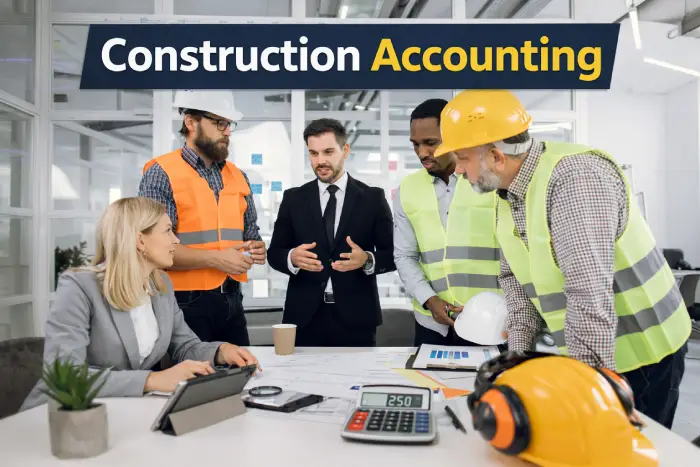
Building a skyscraper or renovating a kitchen requires precision, planning, and the right tools. Managing the money behind those projects requires the exact same level of detail. Construction Accounting is a distinct beast compared to standard business bookkeeping. If you run a retail store, you sell a product, collect cash, and restock. In construction, you might work on a project for months before seeing the final payment. This guide breaks down the complexities of the industry. We will explore how to manage job costs, handle long-term contracts, and choose the right software to keep your business profitable.
Why Construction Accounting is Different
Standard accounting usually looks at the business as a whole. However, construction accounting focuses heavily on individual projects. Every job site is like a temporary, standalone business. You have to track travel, materials, labor, and overhead for each specific location. If you treat a construction firm like a standard retail business, you will lose track of profitability very quickly.
Read also: Washington State Capital Gains Tax: A Comprehensive Guide for Residents
The Challenge of Decentralization
Most businesses operate under one roof. Construction companies operate everywhere. Your assets—crew, equipment, and materials are constantly moving.
- You must track costs across multiple locations simultaneously.
- Equipment usage needs to be allocated to specific jobs.
- Labor rates may change depending on the prevailing wage of the job site location.
Long-Term Contracts
A coffee shop transaction takes seconds. A construction contract can last years. This creates a massive challenge for recognizing revenue. You cannot simply wait until the end of a two-year project to record profit. You need methods to track progress and financial health while the work is still ongoing.
Variable Cost Types
Costs in this industry fluctuate wildly. The price of lumber might spike in week three, or a change order might alter the scope in month four.
- Direct costs (materials and labor) are easy to see.
- Indirect costs (supervision, equipment repairs) are harder to assign.
- Overhead (office rent, insurance) must be carefully allocated to ensure bids are accurate.
Standard Accounting vs. Construction Accounting
|
Feature |
Standard Accounting |
Construction Accounting |
|---|---|---|
|
Focus |
Company-wide profitability |
Project-level profitability |
|
Sales Cycle |
Short-term (immediate) |
Long-term (months or years) |
|
Inventory |
Stock held for resale |
Materials purchased for specific jobs |
|
Revenue |
Recognized at point of sale |
Recognized via percentage of completion |
|
Expenses |
Operating expenses |
Cost of Goods Sold (COGS) & Job Costs |
The Role of the Construction Accountant
This isn’t just about data entry. A construction accountant acts as a financial project manager. They bridge the gap between the dusty job site and the clean corporate office. Their primary goal is to ensure that every project stays in the black. They analyze labor hours, material waste, and billing cycles to prevent cash flow gaps.
Read also: Capital Gains Tax on Inherited Property: What You Need to Know
Essential Skills and Duties
The daily life of an accountant in this sector involves high-level analysis. They are the gatekeepers of project financial health.
- Job Costing: Assigning every screw and hour of labor to the correct project code.
- Change Order Management: Adjusting the budget when the client changes their mind.
- Retainage Tracking: Managing the withheld money (usually 5-10%) released only upon project completion.
- AIA Billing: preparing complex progress billings required by architects and banks.
Finding the Right Talent
The demand for specialized accountants is high. You might be a firm owner looking to hire, or a professional searching for construction accounting jobs near 44126. Regardless of whether you are in a specific zip code or a major metropolitan hub, the requirement remains the same: specialized knowledge. General accountants often struggle with the nuances of WIP schedules and committed costs.
Mastering Construction Project Accounting
At the heart of the industry is construction project accounting. This is the process of tracking financial results on a job-by-job basis. If you don’t separate your costs by project, you might have one profitable job subsidizing three losing jobs, and you wouldn’t even know it.
Construction in Progress Accounting
One of the most confusing concepts for newcomers is construction in progress accounting (CIP). This is an asset account, not an expense account. When you buy materials for a job that isn’t finished, you haven’t technically “spent” that value yet in terms of profit and loss. It is an asset sitting on the job site.
- CIP records the costs associated with a project that is not yet complete.
- It prevents expenses from hitting the income statement too early.
- It matches revenues with expenses in the correct period.
Revenue Recognition Methods
How do you tell the IRS how much money you made on a building that is only half-finished? You have a few options.
Revenue Recognition Methods
|
Method |
Definition |
Best Used For |
|---|---|---|
|
Cash Method |
Record revenue when cash is received and expenses when paid. |
Very small contractors; simple projects. |
|
Completed Contract |
Recognize all revenue and expenses only when the project is done. |
Short-term projects; minimizes interim tax. |
|
Percentage of Completion |
Recognize revenue based on how much work is finished. |
Long-term contracts; preferred by banks/sureties. |
The Digital Shift: Software Solutions
Gone are the days of managing multi-million dollar projects on a spreadsheet. To scale, you need specialized accounting software for construction. Modern software handles the heavy lifting. It automates retainage, simplifies payroll for multiple unions, and generates real-time WIP reports.
Choosing the Right Tools
The best construction accounting software is one that integrates with your field operations. You want a system where the site supervisor enters hours, and the accounting system sees them instantly.
- Look for strong job costing capabilities.
- Ensure it handles AIA billing formats.
- Verify it can track subcontracts and insurance certificates.
Integration is Key
Standalone accounting tools are useful, but construction accounting and project management software combined is powerful. When these two systems talk to each other, you reduce double entry. The project manager sees the budget in the field, and the accountant sees the progress in the office.
- Procore: Excellent for project management, integrates with accounting tools.
- Sage Intacct: A heavyweight in the construction industry accounting software space.
- QuickBooks Enterprise: Good for mid-sized firms, specifically the Contractor edition.
Essential Features for Construction Software
|
Feature |
Why You Need It |
|---|---|
|
Mobile Access |
Allows field teams to submit expenses and time from the site. |
|
Change Order Tracking |
Prevents “scope creep” from eating into your profit margin. |
|
Subcontractor Management |
Tracks insurance expiration and lien waivers automatically. |
|
WIP Reporting |
Shows over/under billing to keep cash flow positive. |
Understanding Search Intent in Accounting
When researching this topic, different users need different things. Whether you are hiring or buying software, understanding your “intent” helps clarify what resources you need.
User Intent and Needs
|
User Search Query |
User Intent |
What They Need |
|---|---|---|
|
“Construction accountant salary” |
Job Seeking / HR |
Salary benchmarks, job descriptions, and certification requirements. |
|
“Best construction accounting software“ |
Purchasing / Research |
Reviews, feature comparisons, and pricing models. |
|
“Construction in progress accounting“ |
Educational / Technical |
Guides on journal entries, asset classification, and tax implications. |
|
“Construction project accounting“ |
Strategic / Management |
Tips on job costing, profitability analysis, and margin protection. |
Commercial Breakdown: General vs. Specialized
Should you use a generic tool or a specialized one? This is the most common question we hear.
Commercial Comparison
|
Feature |
General Software (e.g., Xero, Basic QuickBooks) |
Specialized Construction Software (e.g., Sage, Foundation) |
|---|---|---|
|
Cost |
Low ($) |
High ($$$) |
|
Learning Curve |
Low / Easy |
High / Complex |
|
Job Costing |
Basic / Limited |
Advanced / Granular |
|
Change Orders |
Manual Workarounds |
Native Feature |
|
Ideal User |
Handymen, Solo Contractors |
GCs, Home Builders, Heavy Highway |
FAQs
What is the difference between markup and margin?
Markup is the amount you add to the cost price to get the selling price. Margin is the percentage of the selling price that is profit. In construction accounting, confusing these two can lead to underbidding and losing money.
How do I handle retention (retainage)?
Retention is usually 5% to 10% of the contract value withheld until completion. You should record this as a “retention receivable” (an asset) rather than asking for it in cash immediately. It is money you have earned but haven’t collected.
Why is job costing so important?
Job costing tells you which projects are making money and which are losing it. Without it, you are guessing. It tracks materials, labor, and overhead against the estimated budget for each specific project.
Can I use QuickBooks for construction?
Yes, specifically QuickBooks Enterprise or Premier Contractor editions. However, as you grow into heavy commercial work, you may outgrow its capabilities and need specific construction industry accounting software.
Conclusion
Construction is a high-risk, high-reward industry. One bad estimate or one unmanaged change order can wipe out the profit for an entire quarter. Mastering construction accounting is the safety net that protects your hard work. It ensures that when you pour concrete, you are also pouring profit into your bank account. From understanding construction project accounting principles to selecting the best construction accounting software, every step matters. If you are looking to streamline your business filings and ensure your compliance is as solid as your foundation, check out BestFiler. We help simplify the administrative burden so you can focus on building.